Awarded Top 4 Education Facility in Australia by the MAGAP (Asia Pacific)
What goes into creating a smooth, even spray tan? Spray tanning training helps you build the technique through structured learning, deliberate practice and useful feedback. If you’re new to the craft, you may be wondering what skills you’ll need, how to practise thoughtfully and when you’ll feel ready to work with clients.
Confidence grows step by step. You’ll learn about skin preparation and solution application, practise controlled movements and develop the communication skills that help clients feel comfortable. With clear guidance and time to practise, these skills can become a foundation for your future in beauty.
This guide covers the essentials, from product knowledge to practical habits that help you refine your technique. You’ll also find guidance on choosing a training approach that suits your goals. For aspiring beauty professionals in Melbourne and across Victoria, including the Eastern and Western suburbs, Brimbank, Hobsons Bay, Maribyrnong, Melton and Wyndham, Tamarua Beauty Academy offers a spray tanning course to help you begin developing your skills.
Curious about spray tanning but unsure where to start? You don’t need to know every detail before you begin. The service combines product knowledge, communication and hands-on technique. Structured learning helps you understand how these parts fit together, practise with a clear purpose and use feedback to improve instead of relying on guesswork.
Spray tanning training develops the knowledge, technique and professional habits needed to provide a considered spray tan service. It gives beginners a practical framework for building their skills one step at a time.
A spray tan service involves more than operating equipment. You need to understand the products you use, ask about a client’s preferences, explain what to expect and pay attention to their comfort throughout the service. These responsibilities connect. A consultation provides context for product choices, while clear explanations help the client understand the process.
There’s also a technical side to learn: getting familiar with the equipment and practising controlled application. Communication and technique develop alongside each other. For example, you can practise describing the service clearly while learning to use steady, deliberate movements. An overview of Sunless Tanning can introduce the broader context and methods behind sunless tanning.
Equipment and industry terms may be unfamiliar at first. A practical demonstration makes instructions easier to apply: you can observe how equipment is handled, what controlled movement looks like and how the steps of a service fit together. This gives you a reference point when you begin practising, without expecting you to master everything straight away.
Feedback makes practice more focused. If a movement feels inconsistent, you can work on a specific element, such as your positioning, pace or communication, rather than trying to change everything at once. Repeating a skill with guidance helps you notice what feels steady and where you need more practice.
That’s the value of preparation over guesswork: you have concepts to draw on, a technique to practise and a way to reflect on what you’re learning. You don’t need to feel confident before you start. Confidence can develop through instruction, practice and reflection, building a stronger foundation for working with clients.
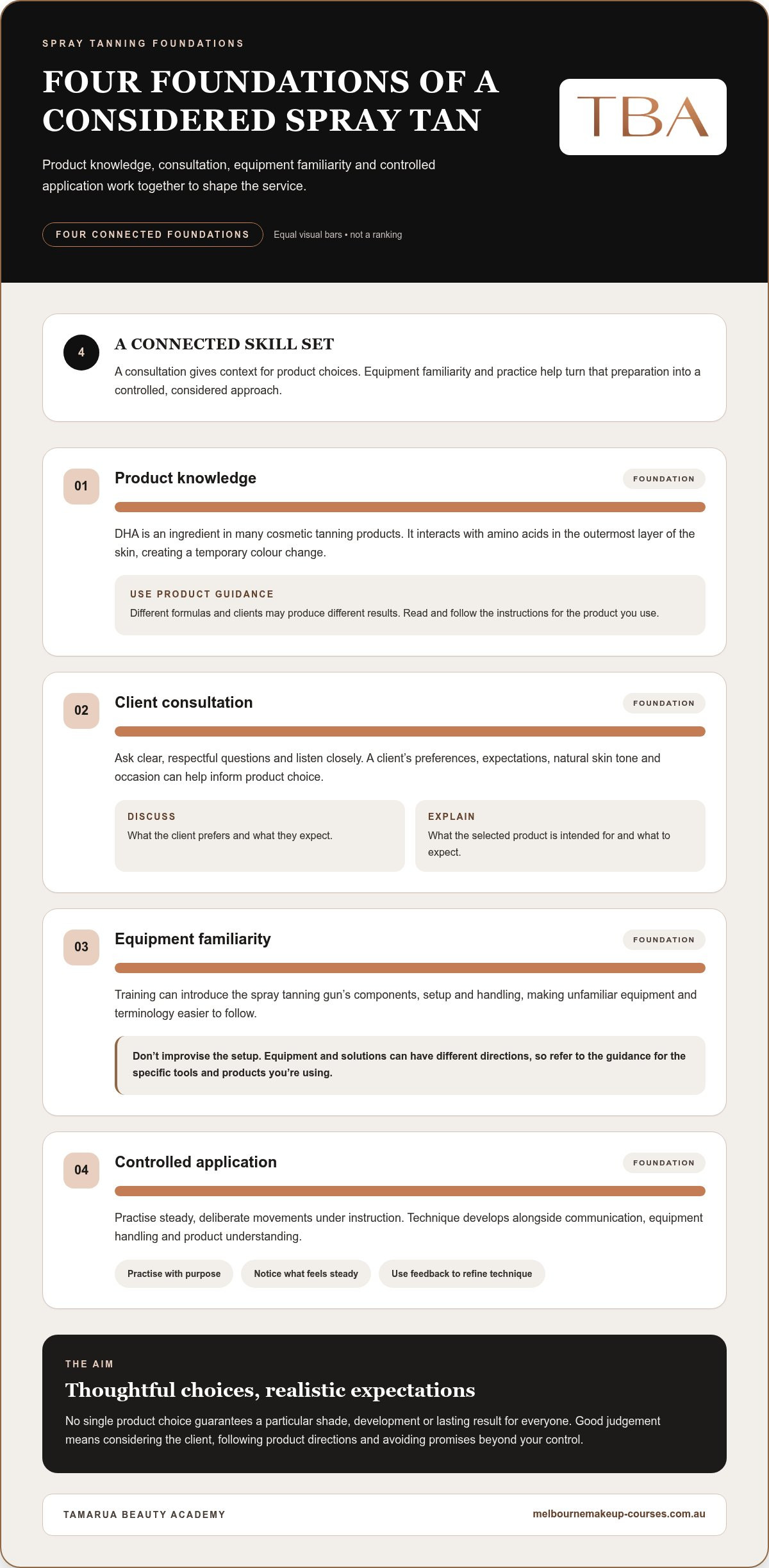
Confident spray tanning rests on four connected foundations: understanding the product, consulting with the client, becoming familiar with the equipment and applying the solution with control. Product knowledge supports considered choices, and a consultation gives you useful context about the client’s preferences and expectations. Equipment familiarity and practice help you turn that preparation into a consistent approach.
Consultation, product choice and controlled technique work together to shape a considered spray tan service. Spray tanning training helps you understand those connections rather than treating each task as a separate trick. The aim is to build the knowledge and judgement to make careful decisions, not to promise one particular colour or result.
Dihydroxyacetone, commonly called DHA, is an ingredient in many cosmetic tanning products. It interacts with amino acids in the outermost layer of the skin, creating a temporary colour change. Understanding this basic role helps you learn how sunless tanning products work, while recognising that different formulas and clients may produce different results.
Consultation helps make product choice more considered. A client may prefer a subtle-looking colour or have a particular occasion in mind. Their natural skin tone and expectations are useful context, too. Practise asking clear, respectful questions, listening closely and explaining what the selected product is intended for. Read and follow the product’s instructions instead of relying on assumptions.
No single choice guarantees a particular shade, development or lasting result for everyone. Skin, preferences and product directions all matter. Good judgement means setting realistic expectations and making a thoughtful choice, not promising an outcome beyond your control.
The spray tanning gun is a working tool, and you need time to learn to handle it steadily. Training can introduce its components, setup and the relationship between product instructions and equipment use. This background makes unfamiliar terminology easier to follow and gives each practice session a clear purpose.
Don’t improvise the setup. Equipment and solutions can have different directions, so get into the habit of referring to the guidance for the specific tools and products you’re using. Practical lessons are where you develop application steps under instruction. Controlled technique depends on understanding your equipment as well as your movement.
During practice, notice how product guidance, client preferences and equipment handling inform your decisions. To build this foundation through structured learning, explore Tamarua’s spray tanning course options.
Choose a learning format by considering where you can absorb ideas, practise deliberately and get useful feedback. In-person sessions can make demonstrations and questions immediate. Online learning can offer flexibility, but practical skills still require purposeful practice and a way to get guidance. Neither format automatically builds confidence on its own.
Use the comparison below as a starting point. What matters is how the learning is structured and whether it helps you turn a lesson into practice.
| Learning format | What it can support | What to consider |
|---|---|---|
| In person | Observing demonstrations in real time, asking questions in context and practising with guidance where the session includes it. | Whether the session’s schedule and setting suit you, and how feedback is provided. |
| Online | Learning around other commitments and revisiting lesson materials when they’re available to review. | How you’ll organise hands-on practice and receive feedback on practical skills. |
A live demonstration can connect an instructor’s explanation with the movements, equipment and decisions involved. You can ask questions as they come up and hear answers in the moment. When guided practice and feedback are included, you can apply a suggestion straight away and notice what changes.
The benefit comes from connecting observation with practice, not simply being in the same room. Look for a learning experience that gives you time to follow the demonstration, clarify unfamiliar points and identify what to practise next.
Online learning can suit people fitting study around work, family or other commitments. If you can revisit a demonstration, return to a particular explanation before practising. Keep a simple practice log: note what you worked on, what felt consistent and one question or adjustment to take into your next session.
Plan for feedback as well as study time. A useful learning routine includes a way to share questions or observations about your practical work and receive guidance. Watching a demonstration builds understanding, but it doesn’t replace hands-on practice. The format matters less than having a workable routine for learning, applying and refining your skills.
Tamarua Beauty Academy offers on-site and live-online short courses across its beauty training, along with a spray tanning course. When choosing how to learn, consider how you prefer to see techniques, fit study into your schedule and get guidance as you practise. Explore the spray tanning course as a way to build your skills through structured learning.
Spray tanning skills develop more steadily when you follow a sequence. Start with the ideas and terminology, observe how they’re applied, then move into guided practice. After each session, reflect on what felt clear and what you want to improve. That gives practice a purpose, instead of repeating movements without knowing what to focus on.
Deliberate practice pairs repetition with specific feedback, giving you a clearer focus for your next attempt.
Work through these stages at a pace that gives you time to understand each one. Follow your instructor’s guidance and the product directions as you build familiarity, rather than trying to master every part at once.
Confidence can be difficult to measure if you only ask, “Am I ready yet?” Instead, keep simple notes on how comfortable you feel with setup, communication, control and following product directions. A brief record helps you see which areas are becoming familiar and where you’d benefit from more support.
Feedback can turn a broad concern into a useful goal. If your note says, “My technique feels inconsistent,” your instructor may help you identify a specific focus, such as maintaining control during a particular movement. Practise that point, then reflect on what changed. Aim for steady progress, not perfection in one session.
Give yourself time to strengthen the foundations before taking on more complex situations. To develop your skills with structured guidance, explore Tamarua’s spray tanning course.
Ready to turn your interest in spray tanning into a skill you can keep developing? Tamarua Beauty Academy is a Melbourne-based beauty training provider offering a spray tanning course with practical demonstrations to help learners connect new ideas with the craft. A supportive learning environment can make the first steps more manageable, whether you’re exploring beauty as a new direction or adding a skill to your professional toolkit.
Building towards professional work takes more than completing lessons. It involves developing knowledge, learning to communicate with clients and practising with care. Training can support your industry readiness, while confidence grows through continued learning and experience. Focus on the skills you’re building and how they fit your goals, rather than assuming a course label alone represents your capability.
Practical demonstrations let you see concepts applied, helping connect explanations with the decisions and movements involved in a service. They give you a useful reference point as you learn. Paired with student support, demonstrations create opportunities to ask questions and develop your skills.
Making time to learn matters, too. Tamarua offers flexible scheduling, with on-site and live-online options across its short courses. Flexible scheduling can help you make room for training alongside other commitments while keeping your learning goals in view.
As you explore training, think about the kind of support that helps you learn best. You might value seeing a technique demonstrated, having space to ask questions or being able to revisit ideas as you develop. A considered pathway supports your progress from initial interest towards greater confidence in your chosen craft.
Start by noting what you hope to achieve. Are you new to beauty training, building on existing experience or exploring spray tanning as a future career direction? Consider how you prefer to learn, too. These reflections can help you make the most of a conversation about your next step, even if you haven’t mapped out your whole career.
Tamarua’s free consultations and student support offer welcoming ways to explore your training goals. Bring your questions and share what you’d like to learn. A conversation can help you consider how a course fits your aspirations.
Explore Tamarua’s spray tanning course and beauty courses.
Your first step doesn’t have to map out your whole career. Choose one practical goal, such as becoming more comfortable discussing a client’s preferences or handling equipment with care, and let it guide what you learn next. With steady practice and thoughtful support, spray tanning training can be the start of a craft you continue to shape as your skills and ambitions grow.
If you’re ready to explore a learning pathway, Tamarua Beauty Academy can help you consider where to begin and what you’d like to achieve. Take a look at the course options and choose a next step that fits your goals.
Explore Tamarua’s spray tanning and beauty courses and take your next step.
Yes. Complete beginners can start with the basics of products and equipment, then build practical skills through guided learning. You might first learn what to ask during a consultation, then practise explaining the service clearly. Treat each new skill as a small milestone rather than expecting to feel fully confident straight away. Instruction, practice and reflection can make the learning journey more manageable.
Tamarua Beauty Academy offers beginner to advanced beauty training, so you can start learning without assuming you need to be experienced in the field. Check the course information for its entry requirements, and prepare by noting unfamiliar product terms or thinking about how to make a client feel comfortable during a conversation. This gives you a useful starting point, whether you’re new to beauty or adding spray tanning to skills you already have.
There isn’t one fixed learning timeline. It depends on the course structure, your starting experience and how consistently you make time to practise. You may understand product concepts before you feel comfortable with practical work. Follow your training sequence, use feedback to choose a clear focus for practice and give yourself time before tackling more complex situations.
Online learning can support study through demonstrations and flexible scheduling, while practical confidence also depends on having a way to practise and receive feedback. Consider how a learning format supports each part of your development, rather than choosing based on location alone. Tamarua offers on-site and live-online short courses across its beauty training, as well as a spray tanning course.
DHA, short for dihydroxyacetone, is an ingredient used in many cosmetic tanning products to create colour on the skin’s outer surface. For learners, the practical takeaway is to understand the product information and explain it in straightforward terms during a client conversation. Always follow the directions for the particular product being used. DHA alone can’t promise a specific shade, how long colour lasts or the same result for every client.
Yes. Spray tanning can be one service within a broader beauty skill set, depending on your interests and career plans. Think about the kind of work you’d like to do and whether you want to develop additional skills over time. Tamarua Beauty Academy is based in Melbourne and offers beauty training, including spray tanning. Training can support your development, but it can’t guarantee employment, clients or a particular income.