Awarded Top 4 Education Facility in Australia by the MAGAP (Asia Pacific)
Could a beautifully fitted spare room still be the wrong setup for the services you plan to offer? It could. Home salon setup requirements victoria involve more than choosing equipment and creating a welcoming space. Your local council’s planning rules, your property and your treatments all shape the checks to make before clients arrive.
If you’re unsure where to begin, start with your address, property arrangements and proposed service menu. Council requirements can vary between areas, and hygiene and safety obligations depend on the services you offer. Working through the checks early can help you avoid costly surprises and plan your home salon with greater confidence.
This guide will help you identify what to investigate for your home and treatment menu. It covers council planning and health registration, premises and infection-control considerations, and essential business-readiness steps. You’ll also see how practical training can strengthen your skills, alongside the separate council and legal checks your setup may require. Whether you’re in Melbourne city, the Eastern or Western suburbs, Brimbank, Hobsons Bay, Maribyrnong, Melton or Wyndham, use your specific property address when checking local requirements.
A home salon setup means preparing a residence to provide beauty services to clients. The practical steps depend on more than the room you choose. Your local council, property circumstances and treatment menu can each affect which permissions or operating requirements to investigate.
Think of the home salon setup requirements victoria as a set of questions to answer for your address and services, rather than one universal approval. General business responsibilities, such as arranging an Australian Business Number (ABN) and registering a business name if you trade under a name other than your own, sit alongside premises and treatment-specific requirements. Business registration doesn’t, by itself, establish that a particular home is suitable for client visits.
Your service menu matters, too. Makeup application and treatments involving skin contact or specialised equipment can raise different questions about hygiene, registration or the premises. For general context on the range of services associated with salons, see Beauty salon. Use official sources to establish which rules apply to your own work. This guide helps you organise your research, but it isn’t legal advice or confirmation that every home setup will be approved.
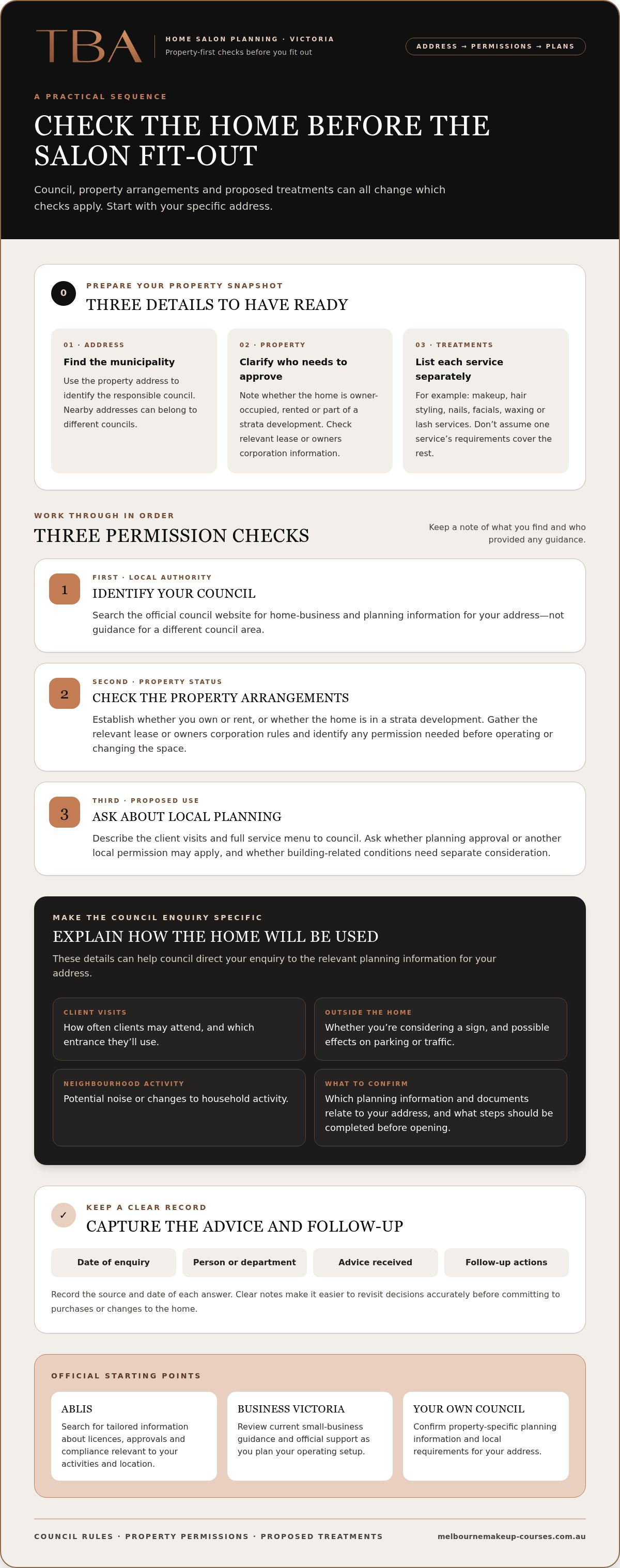
Before you research, write down the property address, who owns or manages it, and every service you plan to offer. This snapshot makes it easier to ask relevant questions and compare the information you receive.
Keep these details together. They’ll help you distinguish local planning questions from health, safety and general business obligations, rather than treating “beauty salon” as one uniform category.
Use official tools to build a reliable starting point, then verify what applies to your specific address. Requirements and approval pathways can depend on local rules and property details.
Record the source and date of each answer, along with any follow-up action. This gives you a clear foundation for the next checks before you commit to purchases or changes to the home.
Before you buy salon furniture, renovate a room or promote your address to clients, establish whether the proposed business activity suits the property. A spare room that works well for makeup appointments may raise different planning or access questions if clients will visit regularly, signage is displayed or equipment changes how the home is used. Home salon setup requirements victoria depend on the specific address, so verify each permission rather than assuming it applies.
Work through these checks in order. Keep a note of what you find and who provided any guidance.
Make your enquiry specific. Explain how often clients may attend, which entrance they’ll use, whether you’re considering a sign, and how appointments could affect parking, traffic, noise or household activity. Ask council which planning information and documents relate to your address, and what steps should be completed before opening. Record the date, the person or department you spoke with, the advice given and any follow-up actions. Clear notes make it easier to revisit decisions accurately.
Don’t treat a quiet street, an existing home office or a neighbour’s business as proof that your own setup is suitable. The proposed activity and address need to be considered on their own circumstances.
If you rent, read the lease for conditions relating to business activity, client visits and changes to the property. Seek written permission where required before installing fixtures, changing access or making other alterations. In a strata property, review owners corporation rules and establish whether they address business use, signs, visitor access or shared parking. For any home, verify whether building or planning conditions affect the proposed use instead of assuming ordinary residential approval covers it.
Then walk through the client journey. Can visitors reach the treatment room without passing through private household areas? Is there enough room to maintain privacy, move safely and store supplies appropriately? Consider ventilation and whether the layout can support your planned services. For treatment-specific hygiene research, consult the Department of Health’s Victorian infection prevention and control guidelines for beauty industries.
As you work through the premises questions, you can develop your skills alongside the setup plan. Explore practical beauty course options to build skills relevant to your planned services, while keeping training distinct from property approvals.
Your treatment menu shapes the preparation your home salon needs. Makeup application has different practical considerations from waxing or a facial, while procedures involving skin penetration may bring additional requirements. Don’t assume a service is exempt or regulated based on its name alone. Use the questions below to identify what to verify with your local council and relevant Victorian authorities.
For each service, check which infection-control, premises, registration and equipment requirements apply to the exact procedure you intend to perform. The Victorian infection prevention and control guidelines for beauty industries are a useful starting point for hygiene research. Confirm how the guidance relates to your service and setup before relying on it.
| Service category | Questions to verify |
|---|---|
| Makeup | How should brushes and applicators be cleaned or managed between clients? What product storage and surface-cleaning practices apply? |
| Nails | What cleaning, disinfection or sterilisation processes apply to tools and work surfaces? Are there service-specific council or premises checks? |
| Facials | Do the products, equipment or techniques affect hygiene and safety requirements? Does any procedure involve skin penetration? |
| Waxing | How should treatment areas, equipment and supplies be managed hygienically? What waste-handling steps should you plan? |
| Spray tanning | What ventilation, product-handling and equipment-cleaning considerations apply to the method you’ll use? |
| Eyelash extensions | What hygiene and safe-use practices apply to products, tools and the client treatment area? |
This comparison is a prompt for official checks, not a ruling on which category needs registration. When verifying the home salon setup requirements victoria for your planned treatments, describe the actual procedure and equipment.
Map the appointment from arrival to exit. Consider where you’ll consult with the client, deliver the service, clean the space and manage used items without mixing them with clean supplies. A clear routine supports a calm, professional experience and helps you spot layout issues before welcoming clients.
Also check workplace health and safety guidance relevant to your work, consumer obligations for the services you provide, and insurance options. Investigate whether public liability and professional indemnity cover suit your activities, premises and client interactions. Build these checks into your service plan so your technique and daily systems develop together.
Use this checklist to turn your research into clear next steps. Work through council and property questions before investing in equipment, renovating a room or advertising your home as a client-facing location. Requirements depend on your address and service menu, so record the source of each answer and revisit it if your plans change.
For every item, mark one status: Investigate, Confirm, Complete or Not applicable. Add a note or follow-up date where useful. The home salon setup requirements victoria you need to address are specific to your circumstances, so use this as a working checklist rather than a universal approval.
Begin with the proposed use and property. Confirm the relevant council’s guidance for your address, then clarify any permissions connected with ownership, a rental agreement or strata rules. Once those questions are underway, check whether the room layout and planned client access can support the treatments you intend to provide.
With the premises pathway clear, build the routines that make each appointment feel considered and professional. Set up processes that suit your business, and check relevant official guidance rather than assuming every service follows the same rules.
Final review date: __________. Revisit the checklist if your treatment menu, property arrangements or council guidance changes. As you prepare, build confidence in the services you plan to offer by exploring practical beauty courses that match your goals.
A thoughtful salon setup is only part of becoming ready to welcome clients. Strong service skills help you work with care and confidence, but they don’t replace council, premises or treatment-specific checks. Keep both sides of your preparation moving: confirm the home salon setup requirements victoria for your situation while developing the techniques behind the services you plan to offer.
Start with your intended menu. If makeup is your focus, build skills in product choice, colour matching and application. Nail services call for different techniques and tool-handling routines, while facials and waxing each involve their own service-specific knowledge. For spray tanning or eyelash extensions, choose learning that relates directly to the treatment you intend to provide. Matching your service menu to your training priorities makes the next step more manageable.
Practical demonstrations and guided practice can help turn new information into techniques you can refine. Feedback from an experienced educator also gives you a chance to strengthen your approach and build confidence before working independently. Tamarua Beauty Academy offers beginner-to-advanced short courses in Melbourne, with on-site and live-online learning, flexible scheduling and one-on-one training. Explore professional makeup training options if makeup is part of the service experience you’re building.
Choose learning based on the skills you want to develop, not simply the equipment you’ve already bought. For example, if you plan to offer both makeup and hair styling, each service requires its own techniques and preparation. A focused course can help you build a stronger foundation in one area, while workshops or further learning may support your development as your goals grow. Training should complement your compliance research, not stand in for it.
Write down the services you’d like to provide, the techniques you already feel confident performing, and the areas where you’d value more guidance. This list can help you make a considered course choice and give you a useful starting point for a free consultation about your learning goals. You don’t need to have every detail of your future salon mapped out before developing your craft.
Keep your learning goals connected to the client experience you want to create. Practising clear consultations, thoughtful service delivery and consistent techniques can help you feel more prepared to welcome clients, while council and property checks continue on their own track.
Ready to develop your skills? Explore beauty courses and take your next step.
Your home salon can grow from a creative ambition into a thoughtful professional practice, one well-chosen step at a time. Keep your plans grounded in the home salon setup requirements victoria that apply to your address and services, while making space to strengthen the craft you want clients to experience. Compliance preparation and skill development work together, but each deserves its own attention.
Choose one practical next move: refine your service menu, note the techniques you’d like to improve, or map out learning that will support your goals. A focused course can help you build confidence through practical beauty training as you shape a polished client experience and your setup takes form.
Tamara Beauty Academy offers short courses across makeup, hair styling, nails and other beauty disciplines. On-site and live-online learning, flexible scheduling and free consultations offer ways to explore a learning path that fits your ambitions.
Explore beauty courses and take your next step. Your salon journey starts with the decisions you make today, and each considered step brings your vision closer.
Possibly, depending on your address, property and services. Council planning approval and health registration are separate questions, so don’t treat one as covering the other. Ask your council whether your proposed client visits or business activity need a planning permit, and what health registration applies to your treatment menu. Home salon setup requirements victoria vary between councils, so advice for another suburb may not apply to your property.
It may be possible, but first check your lease and get any required permission from your landlord or property manager. A lease may restrict business activity, visitors or alterations, even if council requirements can be met. For example, installing a basin or putting a sign near the entrance could raise separate property questions. Keep written permission with your records, then verify local council requirements for the address and services.
Beauty businesses may need to register with their local council under Victorian public health requirements, and the applicable pathway can depend on the services offered. Contact council with a precise treatment list, including whether any procedure involves skin penetration, rather than describing the business only as a “salon”. Ask what registration category and premises information apply, and keep the response with your business records. Don’t assume a home-based operation is automatically exempt.
Not necessarily. A studio offering makeup application may raise different health, equipment and premises questions from a room where you provide facials, waxing or another treatment. The room’s label doesn’t determine the rules; the activities and products used matter. If your menu expands, reassess the setup and ask council whether the additional service changes registration or premises requirements. Plan hygiene routines around the actual work performed.
Having clients visit your home doesn’t, by itself, determine whether you need an ABN. If you’re operating a beauty business, check your eligibility and obligations through the Australian Business Register, where ABN applications are free. Keep business income and expense records from the outset, and consider whether you need to register a business name if you trade under a name other than your own. An ABN doesn’t replace council approvals.
Possibly, but check before putting up a sign or directing clients to park at your home. Council planning rules, property conditions or owners corporation rules may affect signage, visitor access and parking. Include the expected number and timing of appointments in your enquiry, as these details help explain the likely effect on the street and household. Don’t rely on a neighbour’s arrangement as evidence that the same setup is permitted for you.
Consider whether public liability and professional indemnity insurance suit your services, client interactions and home setup. Also tell your home insurer that you plan to operate a business from the property, and ask how that affects your existing cover; household policies may treat business activity differently. Review cover for treatment equipment and products as well. Describe your actual services when comparing policy terms, and keep a record of the cover details you select.