Awarded Top 4 Education Facility in Australia by the MAGAP (Asia Pacific)


What if your first step towards a nail career isn’t mastering intricate nail art, but learning to deliver safe, consistent services clients can trust? If you’re searching “how to become a nail technician Australia”, it’s understandable to feel unsure where to begin, especially when you have questions about training, hygiene and finding your first clients.
You can build your skills step by step. A confident start comes from learning nail fundamentals, practising carefully and developing client-care habits that support a professional service. Training offers a structured way to bring these elements together, without expecting you to know everything on day one.
In this 2026 roadmap, you’ll explore which skills to learn first, how training and credentials fit into the Australian industry, and why hygiene and local requirements deserve attention as you prepare to work. You’ll also find practical ways to build experience and prepare for your first clients. Whether you’re new to the craft or ready to turn your interest into a career, there are clear steps you can take to grow your confidence.
A nail career combines hands-on technique, creativity and attentive client care. Searching “how to become a nail technician Australia” often leads to a bigger question: what does the work involve, and how can you prepare to do it professionally?
A nail technician provides nail care and, where their training supports it, polish and enhancement services, while consulting with clients and maintaining a safe, professional workspace. The Nail technician overview offers a general introduction to the profession, including common duties and health and safety considerations.
For a visual introduction to the career, watch this overview:
A considered appointment starts with a conversation. Discuss the client’s preferences, ask what result they want and observe their nails and surrounding skin before planning a suitable service. Clear communication helps set realistic expectations, while checking in during the appointment helps you respond to the client’s comfort.
Depending on their training and the service planned, a technician may provide a manicure, apply polish or create nail enhancements. They can also explain aftercare so clients know how to look after their nails. Appropriate techniques and services depend on the practitioner’s competence, the client’s needs and the scope of the workplace.
Salon or beauty-studio employment may provide a shared workspace and established appointment processes. Mobile work brings services to clients, so transport, portable equipment and appointment timing become part of the job. Self-employment can offer greater control over services and scheduling, alongside responsibility for bookings, records and day-to-day administration.
Every setting calls for more than technical ability. Training helps you develop your craft, and supervised or deliberate practice helps build consistency. Neither replaces understanding the local requirements that apply to your work. If you’re considering home-based services, verify relevant council and premises requirements for your location before you begin. Hygiene and safe working practices matter in every setting.
If you’re researching “how to become a nail technician Australia”, think of the pathway as a sequence: understand the role, choose training that fits your goals, develop your technique and prepare for the setting where you want to work. A certificate can mark course completion, but it isn’t the same as demonstrating safe, consistent practical competence.
Look for learning that goes beyond demonstrations. Practical application, feedback on technique and clear coverage of the skills you want to develop can help you turn foundational knowledge into repeatable work. Training formats differ: a nationally recognised qualification is distinct from a workshop or short course, and each may suit a different learning goal.
To check a qualification, search its exact title or code on the Australian Government’s Certificate III in Nail Technology listing on training.gov.au. Review the qualification details and compare them with the credential named in the course information. You can also explore nail and beauty courses to compare structured learning options in Melbourne.
Within your training scope, work on a repeatable process: preparing the nail, applying products carefully, removing them appropriately and refining the finish. Practise on suitable models with informed consent, and use tutor feedback to identify improvements before building speed or trying more complex techniques.
Keep a simple portfolio of clear images that show your progress and finished work. Get permission before taking or sharing identifiable client photos, and respect their privacy. A portfolio can help you reflect on your development and show your style, but it doesn’t guarantee employment or clients. Keep strengthening your craft while preparing for the practical expectations of your chosen workplace.
Beautiful results matter, but trust grows through the whole appointment: a clean, organised workspace, thoughtful communication and consistent care from start to finish. As you explore how to become a nail technician Australia, treat hygiene and client care as core professional skills, not extras to add later.
Make hygiene a repeatable part of every service. Prepare clean work surfaces, use appropriate tools, maintain sound hand hygiene and handle single-use items as directed by your training and current guidance. Reusable tools need to be cleaned and disinfected using suitable methods. Don’t assume that wiping a tool is enough. Follow product instructions for handling, storage and removal, and use suitable ventilation for the products and service involved.
Requirements can depend on the service and where you operate. If you’re setting up in Victoria, verify current state, local council and premises requirements for your intended services and work location before you begin. Training provides a foundation, while up-to-date local guidance helps you apply safe practices in your workplace.
Strong technique comes from control and consistency. Practise nail preparation, measured product application, a neat finish and careful removal within the scope of your training. Ask for feedback on specific details, such as even coverage or how you manage each stage, then focus your next practice session on one improvement at a time.
Client care starts before the service. Ask what result the client wants, listen to preferences or sensitivities they mention, and explain suitable options in clear language. Set realistic expectations, check comfort during the appointment and offer relevant aftercare guidance. If a request falls outside your training or competence, say so rather than attempting a technique you’re not prepared to perform.
Professionalism also shows in the details clients may not see straight away. Allow realistic appointment times, keep accurate service records where appropriate, and share aftercare instructions clearly so clients know how to maintain their result. These habits support a considered experience and help you learn from each appointment. Reflect afterwards: What went smoothly? What feedback did you receive? Which skill will you practise next? Small, specific improvements build confidence while keeping client wellbeing at the centre of your work.
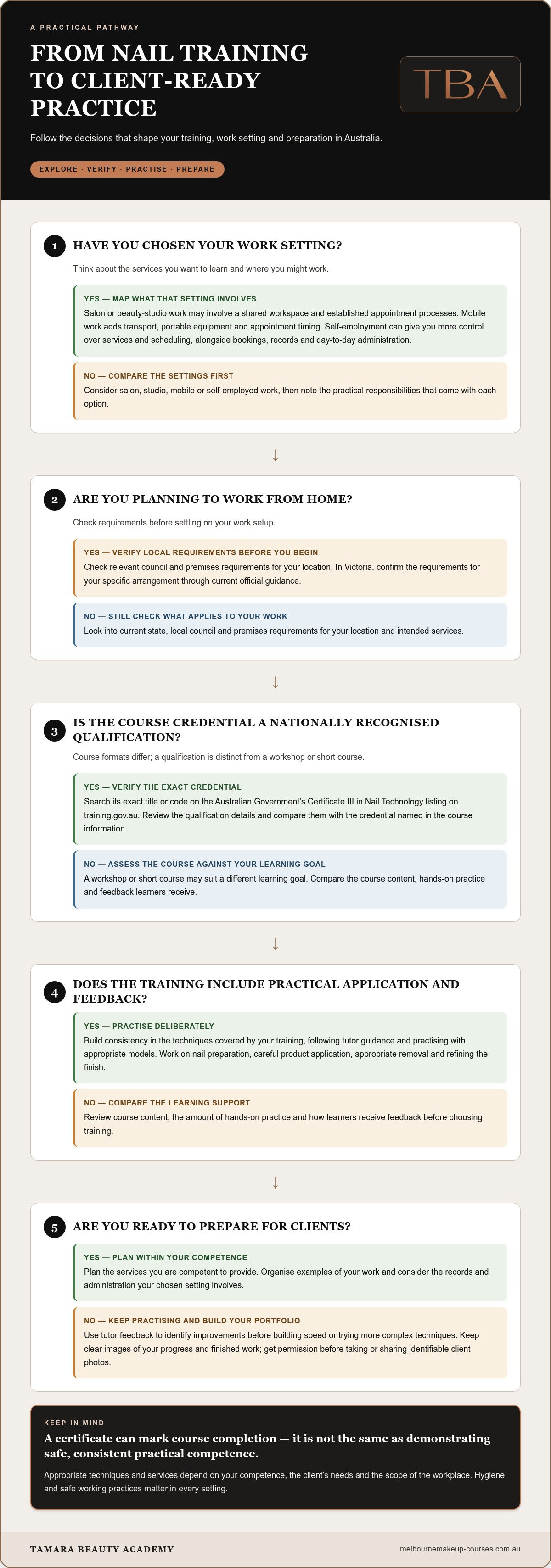
Your first bookings are easier to manage when you organise the practical details before a client arrives. A useful answer to “how to become a nail technician Australia” includes more than learning techniques: prepare a clear, comfortable service experience and understand the obligations that apply to your own work setup.
Readiness checklist: be technically ready to perform each service you offer, then separately prepare your workspace, records and business setup for the way you plan to work.
Start with a focused service menu. List only services and techniques you’ve been trained to perform and practised sufficiently, and describe each clearly so clients know what to expect. Organise suitable products and clean tools, then set up a comfortable workspace and a repeatable appointment process.
Prepare a simple consultation routine to discuss the client’s preferences and relevant sensitivities, along with a clear way to share aftercare guidance. Keep only the information you need for your work, store it responsibly and respect client privacy. Allow enough time for each appointment so preparation, the service and tidy-up aren’t rushed.
Requirements can depend on where and how you operate. A Melbourne home-based setup, a rented studio space and mobile work may raise different premises or council questions. Before accepting bookings, check current local council guidance for your intended location and service, and clarify any relevant premises requirements. Business registration, tax and insurance obligations also depend on individual circumstances. Use official Australian Government resources, such as business.gov.au and the Australian Taxation Office, to understand which steps apply to you.
Keep practising within your training guidance and seek constructive feedback before adding new services to your menu. Ask a tutor or experienced supervisor to review a specific detail, such as your preparation routine, application control or finish, then practise that skill deliberately.
With informed consent, take clear portfolio images that show your work accurately. Explain what service was performed, avoid editing photos in ways that misrepresent the result, and get permission before sharing identifiable images. A small, honest portfolio can help prospective clients understand your style without overstating your experience.
Build word of mouth through punctual appointments, thoughtful communication and reliable service. Invite feedback, respond professionally and let clients choose whether they’d like to recommend you. If structured practice would help you prepare, explore nail training courses at Tamarua Beauty Academy in Melbourne as you plan your next step.
The right learning format is one that helps you build the skills you want, practise thoughtfully and receive useful guidance along the way. If you’re working out how to become a nail technician Australia, compare training by its learning experience and fit with your goals, not by its title alone.
A structured course can provide a planned learning pathway, while a workshop may suit someone looking to focus on a particular area. One-to-one learning can provide an individual setting for questions and feedback. Consider how much practical work is included, whether demonstrations are paired with guided practice, and how you’ll receive feedback on your technique.
Live-online learning and in-person practice can play different roles. Online sessions may help you fit learning around work or other commitments, while in-person practice gives you the opportunity to develop hands-on technique with direct guidance. As you compare options, match the course content to the skills you want to strengthen, such as preparation, product application or finish quality. A course format or title alone doesn’t guarantee a particular credential or career outcome.
Tamara Beauty Academy is a Melbourne-based training institute offering nail courses and flexible learning options, including on-site and live-online learning. Explore the beauty training options in Melbourne and consider which approach best supports your next stage of learning.
Start with a clear goal. You might want to build foundational nail skills, gain more guided practice or develop confidence in a technique you’ve already encountered. A free consultation gives you an opportunity to discuss your learning goals and consider a suitable direction.
Professional confidence grows through steady practice, thoughtful feedback and supportive guidance. You don’t need to have every step mapped out before you begin. Take a look at the nail course options and choose a learning step that brings your creative ambitions closer to confident, considered work.
Building a career in nails is a practical journey: develop your technique through suitable training, practise until your work feels consistent, and make client comfort and hygiene part of every service. Understanding how to become a nail technician Australia also means preparing for your chosen work setting and checking the local requirements that apply to it.
You don’t need to master every technique at once. Focus on foundational skills, seek useful feedback and build confidence through practice. The right learning environment can help you make steady progress while fitting study around your commitments.
Tamara Beauty Academy is a Melbourne-based beauty training institute offering nail courses alongside other beauty training. With flexible scheduling, practical instruction and free consultations, it can support you as you explore your learning goals. Explore nail training options at Tamara Beauty Academy and take the next step that suits you.
Your professional confidence grows one skill, one thoughtful practice session and one client interaction at a time. Start where you are, stay curious and give your ambition room to grow. Tamara Beauty Academy offers training for learners across Victoria, including Melbourne city, the Eastern suburbs, Western suburbs, Brimbank, Hobsons Bay, Maribyrnong, Melton and Wyndham. Explore the nail course options to discuss your learning goals.
To understand how to become a nail technician Australia, begin by exploring the role, then choose training that matches your goals and offers opportunities to practise. Build your technique with feedback, learn consistent hygiene habits and prepare for the requirements of your intended work setting. Before taking clients, organise a service menu that reflects the skills you’ve trained and practised, along with a clear consultation and aftercare process.
There’s no mandatory national licence for nail technicians, but a relevant qualification can help demonstrate your training and may be required by employers or insurers. The Certificate III in Nail Technology (SHB30321) is a nationally recognised qualification. Short courses and workshops can also develop specific skills, but they aren’t automatically equivalent to a nationally recognised qualification. Check a credential and training provider through Australian Government training information before enrolling, or explore registered vocational education providers such as apeiro.edu.au to see how accredited Australian training is structured.
There isn’t one set timeframe: it depends on the course, how it’s delivered, your study pace and how much practice you need to build confidence. A short course may focus on selected techniques, while a broader qualification covers a wider training pathway. Consider the learning and practice involved rather than choosing by duration alone. Ask what skills are covered, how assessment works and what support is available as you learn.
Yes, you can start as a beginner; previous salon experience isn’t essential to begin learning. Choose training that introduces foundational techniques, then practise within its guidance and seek feedback before offering services to clients. Build confidence gradually, starting with the skills you’ve practised rather than taking on techniques beyond your current competence. A portfolio can document your progress, provided you get consent before taking or sharing identifiable client images.
Nail technicians need controlled application, careful preparation and removal, attention to finish and consistent hygiene practices. Client skills matter just as much: listen to preferences, discuss realistic options, check comfort and explain aftercare clearly. Good time management and accurate record keeping also support a considered service. Beginners can improve steadily by inviting feedback, reflecting on specific parts of each practice session and focusing on one technique at a time.
Home-based nail services may be possible, but requirements depend on your location, premises and intended services. Before setting up, contact your local council and consult relevant Victorian Government guidance about applicable health, planning or premises obligations. Requirements can differ between Melbourne’s eastern and western suburbs and other Victorian areas, so don’t assume one arrangement applies everywhere. Also consider your business, tax and insurance responsibilities, which depend on your circumstances.
Online learning can support your understanding of techniques, products and service processes, but job readiness also depends on practical competence. Look for opportunities to practise, receive useful feedback and demonstrate skills safely before working with clients. Live-online learning and in-person practice may suit different parts of your development. Tamara Beauty Academy is Melbourne-based and offers on-site and live-online beauty training, including nail courses, with flexible options for learners.