Awarded Top 4 Education Facility in Australia by the MAGAP (Asia Pacific)


When lash extensions shed early, the adhesive isn’t the only possible cause. If retention looks uneven or a client returns with more fallout than expected, review your application, the salon environment and the client’s aftercare before deciding what to change. These lash extension retention tips offer a practical way to investigate the pattern instead of relying on a one-size-fits-all rule.
We’ll look at how application habits, adhesive handling, environmental conditions and client care can each affect wear, and what clues may point towards one area or another. You’ll also find a repeatable way to review retention and make measured adjustments, rather than changing several things at once. For lash artists across Melbourne and Victoria, including Melbourne city, the Eastern and Western suburbs, Brimbank, Hobsons Bay, Maribyrnong, Melton and Wyndham, consistent observation and guided practice can help make retention review part of your professional routine.
Retention describes how well extensions remain attached between appointments. It’s useful to assess, but it doesn’t mean every client’s set will look the same or last for an identical length of time. Natural lash cycles, styling choices, application and aftercare can all affect what you see at a refill.
Put simply: natural shedding is an extension falling away with its natural lash; premature extension loss is an extension detaching while the natural lash remains. That distinction gives you a more useful starting point than judging retention by how full the set looks at a glance.
At a refill or follow-up, assess which extensions remain attached and note how the set has changed since application. Check whether extensions are still attached to natural lashes, whether losses are spread evenly or concentrated in particular areas, and whether there are isolated gaps. A client’s impression matters, but it doesn’t tell the whole story on its own.
Build a consistent record. Note the appointment date, chosen style, products and application conditions, as well as the client’s aftercare feedback and what you observe at the next visit. Comparing these details across appointments can reveal a recurring pattern. One unexpected result may simply need closer investigation. Avoid treating a particular number of remaining extensions as a universal pass or fail: sets, natural lashes and appointment intervals differ.
Adhesive matters, but it’s one part of a connected process. Natural lashes that aren’t properly prepared, unsuitable adhesive contact, placement and room conditions may all contribute to early loss. Client care can also influence wear. Changing adhesive straight away might not address the cause, and blaming the client before reviewing the application is just as unhelpful.
Start with what you can observe. If extensions are detaching while natural lashes remain, review preparation, placement and the conditions during application before deciding what to change. If extensions are coming away with natural lashes, consider natural shedding as a possible explanation, then compare your observations with the client’s usual pattern and care routine. Appearance alone can’t confirm the cause.
Style is another useful point of comparison. Classic extensions use individual extensions, while volume sets use fans, so the set’s design can affect how gaps appear and how you assess a refill. A comparison of classic and volume lash extensions can help you understand those style differences without assuming one should retain identically to the other.
Use these lash extension retention tips as a prompt to observe before you adjust. One poor result doesn’t prove the adhesive is faulty. A clear definition, consistent notes and a calm review of the full process give you a stronger foundation for deciding what to investigate next.
Adhesive doesn’t work in isolation. Its behaviour depends on its formulation, the manufacturer’s directions and the conditions in the work area. Temperature and humidity can influence curing, so a technique that works well in one room may need review when the environment changes. Treat the product guidance as your starting point, not a generic set of figures copied from another adhesive or salon.
Cyanoacrylate adhesive cures in response to moisture, but suitable working conditions vary by product. Too much or too little humidity can affect how it cures and the bond it forms. A hygrometer helps you measure the room rather than guess. Record humidity and temperature during appointments, then compare them with the adhesive’s instructions and your application notes.
Consistent room-condition records turn changing retention from a mystery into a pattern you can investigate. If results shift, check whether the work area changed before adjusting your routine. Make one change at a time, keeping it within the adhesive manufacturer’s directions. A range published elsewhere, including a competitor’s suggested range, is an example to assess, not a universal target.
Product handling matters as much as room conditions. Check the bottle’s condition, follow its storage directions, record when it was opened and use the manufacturer’s product-specific guidance on replacement. Don’t assume every adhesive has the same usable life. If its appearance or performance changes, review the instructions and your records before using it again.
Prepare natural lashes so the bonding area is clean and free from residue that could interfere with contact. Use a controlled amount of adhesive, then place the extension carefully so it makes secure contact with the natural lash. The goal isn’t to follow a universal attachment measurement. It’s to apply the product and technique correctly for that adhesive and lash.
Style influences the work, too. Classic extensions and volume fans differ in how they’re formed and applied, so technique and product handling need to suit the set you’re creating. Practical learning can connect adhesive theory with precise application through demonstrations and feedback. Explore eyelash extension courses to keep developing those skills.
Retention concerns are easier to investigate when you compare what you observe with what happened during the appointment and between visits. A few extensions missing in one area don’t automatically point to poor application or aftercare. Look for patterns across appointments, and consider artist technique, client habits and natural lash variation together before drawing conclusions.
Artists can review the consultation, cleansing, isolation, extension suitability and consistency of placement. The extension’s weight and length should suit the natural lash; an extension that overwhelms it may affect wear and comfort. Record changes to technique or products alongside your observations, so you can see whether a pattern began after an adjustment instead of relying on memory.
Clients influence wear through how they follow the aftercare instructions you provide and what they report between appointments. Ask about changes in their routine, such as cleansing or handling, without assuming they’ve done something wrong. Natural lash condition and shedding also vary from person to person, so identical services won’t necessarily produce identical retention. Keep the conversation supportive and specific.
Use this comparison to guide your next review, not to diagnose from appearance alone:
| Observed pattern | Possible factors | What to review next |
|---|---|---|
| Similar early loss across several clients | Application routine, product handling or work conditions | Compare appointment records and recent changes |
| One client reports recurring wear concerns | Aftercare habits, natural lash variation or a technique detail | Discuss their routine and compare observations across visits |
| Gaps appear unevenly or in a localised area | Placement, isolation, habits affecting one area or natural shedding | Inspect the pattern closely and review application notes |
| Loss varies from visit to visit | Changing conditions, routine or natural lash cycle | Track details over multiple appointments |
One isolated result is a clue, not a verdict. Repeated patterns across appointments are more useful. If the same issue appears for different clients, review the steps they have in common. If it recurs for one client, explore their individual routine and lash pattern with care. These lash extension retention tips work best as a framework for asking better questions, not assigning blame.
Building that judgement takes practice. Structured eyelash extension training in Melbourne can help you connect consultation, technique and client communication, so each appointment gives you clearer information to learn from.
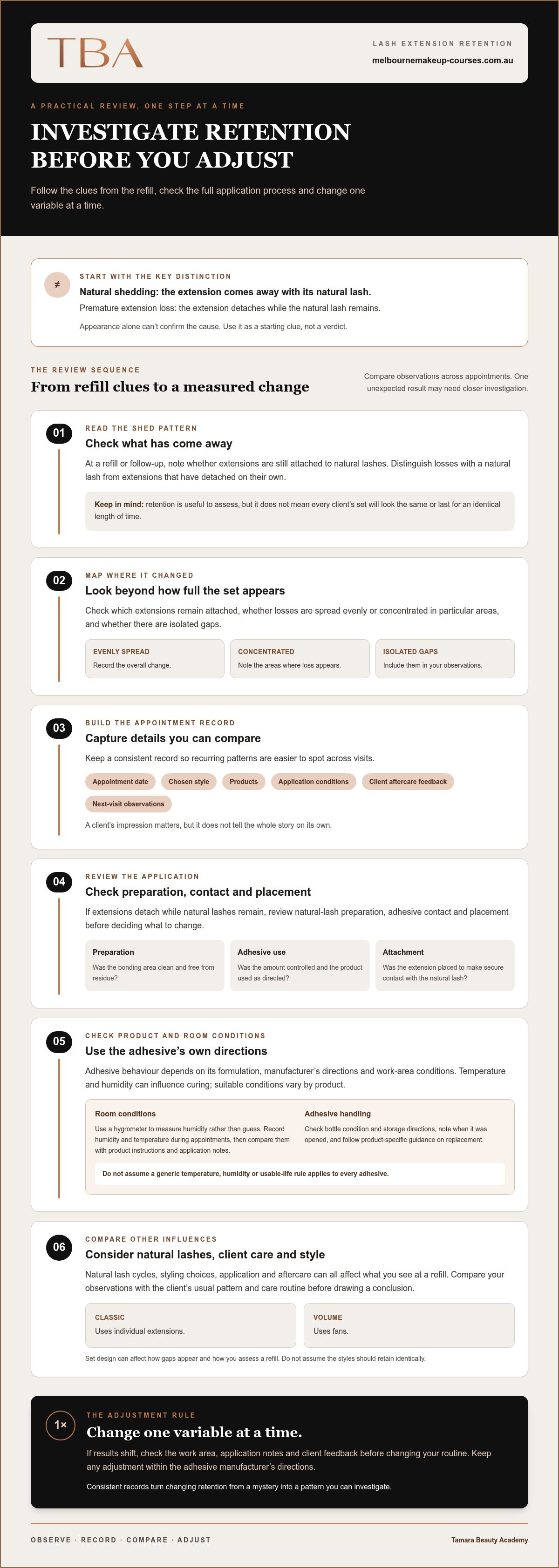
A disappointing refill is a reason to investigate, not a cue to change everything at once. First establish what happened, then work through the evidence in a consistent order. Widespread early loss may call for a different review from a few localised gaps, while extensions shed with natural lashes may reflect the lash cycle. None of these patterns confirms a cause on its own.
Use the same sequence each time. It helps you compare appointments fairly and explain your reasoning clearly to clients.
Look for a repeatable pattern across follow-ups before treating one result as proof that a change worked. For example, if early loss follows a change in room conditions, compare your records with the adhesive instructions before altering your setup. If you change products, revisit that product’s directions rather than assuming your previous workflow still applies. Change one factor at a time, so you can learn what actually improves retention.
If the pattern remains unclear, return to the fundamentals and seek constructive feedback on your technique. These lash extension retention tips are most useful when they support a calm, evidence-led review, not a quick guess or a client-blaming conversation. Keep your notes factual and share observations with care.
Ongoing learning can help you refine how you assess application, adhesive handling and client communication together. Explore eyelash extension courses to build your skills through structured study and practical learning.
Troubleshooting becomes more valuable when it leads to a repeatable learning habit. After reviewing a retention concern, record what you noticed, what you changed and what you’ll observe at the next suitable follow-up. Over time, these notes can help you recognise your strengths and identify details that deserve more practice. The aim isn’t to chase a flawless result for every client, but to make thoughtful, informed decisions and keep refining your craft.
Demonstrations make technique visible, while guided practice gives you space to build control. You can focus on isolation, placement and adhesive handling, then consider how consultation choices shape the set. Constructive feedback can reveal habits that are hard to notice while concentrating on the work, such as inconsistent placement or difficulty maintaining separation. Use that insight to practise a specific skill, then reflect on what feels clearer.
Keep your learning focused. Choose one technique to refine, ask for feedback on that element and record the next step you want to practise. For example, if feedback highlights uneven placement, focus on consistency before changing products or altering several parts of your workflow. This measured approach turns general lash extension retention tips into practical habits you can carry from one appointment to the next. In professional beauty education, institutions like 5T Beauty Academy similarly stress the value of guided, hands-on clinic hours to instil lasting technical discipline. Training and practice can strengthen your decision-making, but no course can promise the same retention outcome for every client.
Clear communication helps clients understand what to expect and how to care for their extensions. Explain aftercare in straightforward language, give the same guidance consistently and invite clients to share relevant changes before their next appointment. A supportive conversation can clarify what they’ve noticed without making them feel blamed. When clients know what information is useful, you can make a more informed assessment together.
Consultation is an ongoing skill, not just a step before application. Practise asking neutral questions about the client’s routine and the timing and pattern of any shedding. Then explain your observations without presenting a guess as a confirmed cause. This builds trust while helping you gather details that can guide your next review. Pair technical growth with thoughtful communication, and each appointment becomes an opportunity to learn.
Whether you’re building foundations or refining established skills, structured learning can help connect demonstrations, practical instruction and client care. Tamarua Beauty Academy offers beginner-to-advanced eyelash extension learning through on-site and live-online short courses. For aspiring lash artists in Melbourne and nearby areas, practical training can help you develop your professional practice.
Strong professional judgement develops through curiosity, reflection and steady practice. Let each retention concern sharpen the questions you ask and the observations you record, rather than push you towards a quick fix. With time, a thoughtful process can help you approach each client as an individual and keep building confidence in your craft.
Tamara Beauty Academy provides practical beauty training, including eyelash extension learning, through on-site and live-online short-course options. With flexible scheduling and support for aspiring beauty professionals, the academy helps students build skills through structured learning. Whether you’re based in Melbourne city, the Eastern or Western suburbs, Brimbank, Hobsons Bay, Maribyrnong, Melton or Wyndham, explore a course that aligns with your professional goals.
Explore Tamara Beauty Academy’s eyelash extension courses and take the next step in developing your lash skills.
A refill is commonly booked around two to three weeks after application, but the right timing depends on the set’s appearance, natural lash shedding and the client’s preferences. Some clients may want an earlier appointment if they prefer a fuller look; others may be comfortable waiting longer. Use the condition of the extensions and natural lashes to guide the conversation, rather than promising a fixed duration.
Yes, humidity can influence how lash adhesive cures, but the effect depends on the specific product and its instructions. If results change during Melbourne’s shifting weather or between work areas, record the conditions at appointments and compare them with the adhesive guidance. A hygrometer gives you a clearer reading than estimating by feel. Avoid copying a humidity target from another adhesive as a universal rule.
Clients should follow the aftercare instructions given for the adhesive used, rather than relying on a universal waiting period. Product directions can differ, so give clear guidance at the appointment and explain how to cleanse lashes without rubbing or pulling. If a client is unsure whether an activity or product is suitable soon after application, direct them back to the specific aftercare instructions you provided.
Oily residue around the lash line may interfere with a clean bonding surface, but oily skin alone doesn’t prove why extensions have fallen out. Ask what products the client uses near their eyes and how they cleanse the area. Give practical, product-specific aftercare advice, including how to keep the lash line clean, without suggesting clients stop using skincare that suits them or making assumptions from skin type alone.
Yes, an extension can shed along with the natural lash it was attached to as part of the lash cycle. A shed extension with a natural lash attached is different from an extension that has detached while the natural lash remains. Clients may notice this more when checking their lashes closely. Encourage them to observe the overall pattern over time, rather than judging retention from one shed lash.
Respond calmly and gather details before deciding what happened. Ask when the loss began, whether it affected both eyes or specific areas, and what the shed extensions looked like. Review your appointment notes and the aftercare guidance you gave, then compare the report with your next observations. If the client also describes eye irritation or an unusual reaction, take the concern seriously and advise appropriate professional assessment.