Awarded Top 4 Education Facility in Australia by the MAGAP (Asia Pacific)


Professional facial training is about turning skin knowledge into thoughtful, practical care. If you’re unsure what professional facials involve, or where foundational skills end and more advanced techniques begin, you’re not alone. Confidence develops through clear guidance, hands-on practice and feedback.
This guide explains the core learning areas behind facial treatments and how theory, technique and client care work together. You’ll get a clearer picture of the skills involved, from understanding skin and consulting with clients to practising treatment steps with care.
We’ll look at how practical ability develops, why a strong foundation matters before progressing to more specialised approaches, and what to consider when choosing a learning pathway in Melbourne or elsewhere in Victoria. Whether you’re new to beauty work or building on existing experience, you can use this guide to identify a useful next step.
Professional facial training combines skin knowledge, treatment technique and client care so you can make considered choices throughout a facial. It goes beyond informal skincare tips: you learn what each step involves and how to adapt your approach to the person in front of you.
Theory gives technique its context. Understanding how skin functions helps you consider why a particular touch, product or treatment sequence may suit one client better than another. Rather than following a routine mechanically, you learn to observe, ask questions and plan with care. This knowledge supports informed choices while keeping your practice within your training.
Start with the skin’s structure and purpose. The epidermis is the outer layer, helping form a protective barrier. Beneath it, the dermis provides support and contains structures such as collagen and oil glands. Skin also helps regulate temperature and respond to touch. For an introductory overview, see What is a Facial?
Skin can vary in oiliness, dryness, sensitivity and visible texture. These characteristics, alongside a client’s stated concerns, can inform choices such as massage pressure or which areas need a gentler approach. The goal is to observe and understand the skin, not to label a rash or diagnose a medical condition. If a concern falls outside your training, recognise that boundary and don’t present a facial as medical advice.
A considered treatment starts with listening. During a consultation, ask about the client’s goals, preferences, sensitivities and relevant skincare experiences, then record information appropriately. This gives you both a clearer starting point and helps shape a treatment plan around the client’s needs instead of relying on a one-size-fits-all sequence.
Set clear expectations, too. Explain the steps in plain language, invite the client to share preferences and check that they feel comfortable as the treatment progresses. For example, if a client prefers lighter pressure, listen and adjust where appropriate. Attentive adjustments can help the client feel heard and reassured.
Aftercare is part of that communication. Give clear, practical guidance about caring for the skin after treatment and what to expect, without making promises or straying beyond your knowledge. Consultation, observation, technique and follow-up advice all contribute to a professional experience.
For learners in Melbourne and across Victoria, Tamarua Beauty Academy offers a facial course as part of its beauty training. The course helps learners connect foundational knowledge with practical technique as they develop their skills.
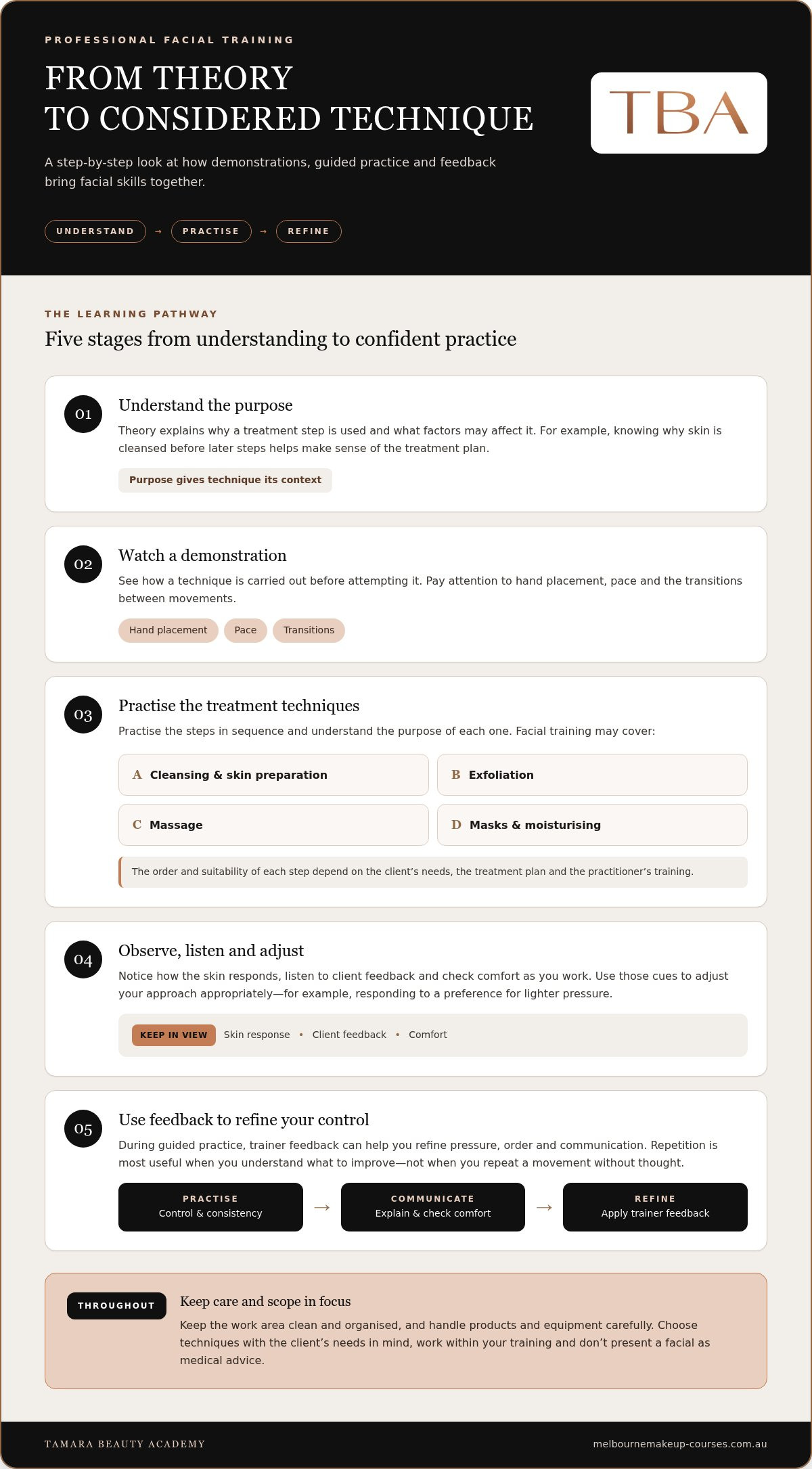
Theory explains a treatment’s purpose; practice teaches you how to carry it out with care. In professional facial training, you can study a technique’s aim and the factors that affect its use, watch a demonstration, then practise the steps in sequence. This turns abstract ideas into movements you can observe, repeat and refine.
Consider skin preparation. Understanding why the skin is cleansed before later steps helps explain the treatment order, while practising the movements develops a steadier touch. As you work, notice how the skin responds, listen to client feedback and adjust your approach appropriately. Keep the work area clean and organised, and handle products and equipment carefully.
Facial treatments can include cleansing, skin preparation, exfoliation, massage, masks and moisturising. The order and suitability of each step depend on the client’s needs, the treatment plan and the practitioner’s training. Don’t include a technique simply because it’s familiar; understand its purpose within the treatment.
For example, the client’s comfort and your observations should inform whether and how exfoliation is used. Massage practice can focus on controlled pressure and smooth transitions between movements. Applying a mask or moisturiser gives you a chance to practise even application and explain each step clearly.
Watching a demonstration first lets you see hand placement, pace and transitions before attempting the sequence yourself. During guided practice, a trainer can give specific feedback on pressure, order and communication. Use that feedback to refine your control and consistency, rather than repeating a movement without understanding it.
Practice also makes client communication feel more natural. Rehearse explaining what you’re doing, checking comfort and responding calmly if someone asks a question or prefers a lighter touch. Repetition connects those words with the treatment steps, helping you keep your attention on the person as well as the technique.
Practical repetition turns facial theory into considered technique: you learn the steps and how to perform them attentively while communicating with the client. Medical-aesthetics education is a separate area. For example, the American Association of Aesthetic Medicine and Surgery (AAAMS) offers training for medical professionals. This illustrates how different types of facial education serve different scopes and goals.
Tamarua Beauty Academy offers a facial course in Melbourne. Practical demonstrations and hands-on instruction help learners see and practise techniques as they develop their skills.
The right starting point depends less on a course label and more on what you already know, where your confidence sits and what you want to learn next. You don’t need salon experience to begin. Interest in beauty work and a willingness to practise are a useful starting point for professional facial training.
Use this comparison to reflect on your learning needs. “Foundational” and “advanced” can mean different things across courses, so compare the learning objectives and intended experience level.
| Foundational learning | Advanced skill development |
|---|---|
| Builds understanding of skin basics, consultation and treatment sequence. | Develops existing knowledge through more tailored planning and technique refinement. |
| Suits learners who are new to facials or want to strengthen the basics. | Suits learners already familiar with core facial practice and ready to extend it. |
| Focuses on clear explanations, demonstrations and supported practice. | Focuses on applying sound fundamentals to varied client needs and treatment goals. |
Look for learning that explains skin basics in accessible language and shows how consultation informs a treatment sequence. Clear demonstrations and supported practice of core techniques help you understand each step instead of simply copying a movement. Progress takes repetition, so expect to leave with skills to keep developing rather than instant mastery.
Find out how questions and feedback fit into the learning process. If you’re unsure why one step comes before another, ask. Understanding the reasoning helps you build a flexible foundation instead of memorising a single routine.
If you understand core facial steps and feel confident consulting with clients, you may be ready to explore more tailored treatment planning or refine particular techniques. Advanced learning is most useful when you can draw on familiar fundamentals and focus on adapting them thoughtfully. Explore the academy’s beauty course information as you consider your next learning step.
Some advanced facial aesthetics training is designed for medical professionals rather than beauty beginners. The American Academy of Facial Esthetics (AAFE), for example, provides training and certification in facial esthetics for medical professionals. This is a distinct learning context from foundational beauty facial education.
Whichever stage you choose, strong consultation and treatment fundamentals support the development of more specialised skills. Start with what you can confidently explain and practise, then build from there. A Melbourne facial course offers a structured next step for learners developing their foundations.
A little preparation can help you arrive ready to take part, even if you’re new to beauty work. You don’t need to master skincare terminology beforehand. Instead, clarify what you want to learn and plan how to build on it afterwards.
Start by identifying what draws you to facial work and what you hope to practise. Are you exploring a beauty career, adding a skill to existing experience or curious about treatment techniques? Your answer can help you focus and ask more useful questions during professional facial training.
Keep your questions in a notebook or on your phone, so you can add to them as ideas come up. Curiosity and readiness to practise matter more than trying to learn everything in advance.
After class, organise your notes while the demonstrations and feedback are still fresh. A learning journal can turn observations into a practical record of your progress. Be specific: which technique did you work on, what feedback did your trainer give, and what would you like to focus on next time?
Ongoing learning helps you develop, but it doesn’t replace the need to work within your knowledge and training. If a technique or client concern falls outside what you’ve learnt, pause and seek appropriate guidance before proceeding. Confidence grows through reflection, careful practice and knowing when to stay within your current scope.
Explore Tamarua Beauty Academy’s facial course options and take a practical next step in Melbourne or elsewhere in Victoria.
Facial skills grow through skin knowledge, guided practice and thoughtful client care. Understanding skin gives context to treatment choices; demonstrations and practice help develop technique; and attentive communication keeps the client’s needs in view. These foundations can help you approach beauty work with greater clarity while continuing to build your skills.
For aspiring practitioners in Melbourne and across Victoria, professional facial training offers a practical way to explore this area of beauty work. You don’t need to have your entire career mapped out before you begin. Consider what interests you now and which skills you’d like to develop next.
Start by reflecting on your experience and ambitions. If you’re new to facials, you may want to build familiarity with treatment steps and client care. If you already have beauty experience, you might want to broaden your skills. Knowing your starting point helps you set realistic expectations and make the most of demonstrations, practice and guidance.
Tamarua Beauty Academy is based in Melbourne and offers a facial course as part of its beauty training. The academy provides practical demonstrations, hands-on instruction and learner support, with certification upon course completion. These are useful features to consider as you choose a learning pathway that fits your experience and goals.
Think about how facial learning could fit into your wider professional development. You might be taking a first step towards beauty work or adding to skills you’ve already begun to build. A learning pathway gives you space to practise, strengthen your understanding and set new goals as your interests develop. Progress is personal and doesn’t need to happen all at once.
Before choosing your next step, consider what you want from training, what experience you’re bringing and which skills you hope to practise. This reflection can help you explore study options with purpose and keep your plans grounded in the learning you’re ready for now.
If facial work has caught your interest, explore Tamarua Beauty Academy’s beauty course options. The academy is based in Melbourne and welcomes learners from Melbourne city, the eastern and western suburbs, Brimbank, Hobsons Bay, Maribyrnong, Melton and Wyndham.
You don’t need every detail of your future mapped out before you begin. A clear next step can be choosing a skill you’re curious about and exploring how structured learning might help you develop it. Professional facial training gives you a pathway to keep building your craft, one considered step at a time.
Tamarua Beauty Academy has supported beauty learners in Melbourne since its founding in 2010. As you consider your direction, think about what you’d like to practise, the experience you’re bringing and how further learning could fit your aspirations. Let those priorities guide your exploration, without putting pressure on yourself to have all the answers today.
Ready to take the next step? Explore Tamarua Beauty Academy’s facial and beauty course options and start building your skills in Melbourne or across Victoria.
Yes. Beginners can use structured learning to develop foundational knowledge and practise skills progressively. Previous salon experience isn’t a universal requirement, although entry expectations vary between courses. Think about whether you’re starting from scratch or building on existing beauty experience, then choose learning that suits your current stage. If skincare terms feel unfamiliar, note them down as questions rather than assuming you need to master them before you begin.
Foundational learning introduces core areas such as skin knowledge, consultation and treatment technique. Advanced learning is generally more suitable once those basics are familiar and you’re ready to refine your approach or explore more tailored planning. Course titles don’t always make the level clear, so compare the learning objectives and intended experience level. A focus on refining existing practice, for example, calls for different preparation from an introduction to facial fundamentals.
There’s no single duration that applies to every course. Training length varies with the topics, practical components and learning format. Consider how time is divided between theory, demonstrations and practice, then think about how study could fit around work or other commitments. Tamarua Beauty Academy offers flexible scheduling across its training. Review the information for the facial course to understand its timing and format.
Facial training can help you develop knowledge and practical skills relevant to beauty work, but completing a course can’t guarantee employment or a particular career outcome. Your next steps may depend on the role you’re interested in, continued practice and any requirements that apply to that work. If you’re planning a pathway in Melbourne or nearby areas such as Brimbank, Hobsons Bay, Maribyrnong, Melton or Wyndham, consider the Victorian requirements relevant to your intended role.
Use your notes to identify specific areas to revisit, such as keeping treatment steps in sequence or explaining what you’re doing clearly. Reflect on trainer feedback and whether your communication helped someone feel informed and comfortable. Practise only within your training and workplace guidance, and don’t move into techniques you haven’t learnt. A simple journal can help you track questions and decide what further learning would be useful.
A course completion certificate and a nationally recognised qualification are different credentials. Completing a course alone does not mean the qualification is nationally recognised. Tamarua Beauty Academy provides certification upon course completion. If you need a credential for a particular role or purpose, read the course information carefully and consider the relevant Australian requirements before relying on it.