Awarded Top 4 Education Facility in Australia by the MAGAP (Asia Pacific)


What if a reliable cut starts before the clippers even touch the hair? Consistent barber tool maintenance isn’t about quick fixes. It’s a simple routine that keeps your tools clean, cared for and ready for the next client.
You already know hygiene matters, but it can be hard to remember what to clean, when to disinfect and how to care for electrical tools without risking damage. Hair and product residue can collect around blades, while missed checks can make wear or loose parts harder to spot. A clear checklist helps you repeat the right steps, even on a busy day.
This guide covers the essentials: removing visible debris before disinfection, following the product label’s contact time, cleaning clippers and shears safely, and setting a practical schedule for daily and periodic care. You’ll also learn what to look for when a tool needs attention. These habits support responsible barbering practice and provide a useful foundation for anyone developing their craft through hands-on training.
Barber tool maintenance is the routine of cleaning, disinfecting where suitable, inspecting and caring for equipment so it’s prepared for use. These steps work together, but they aren’t interchangeable. Brushing hair from a blade removes visible debris; it doesn’t clean away all residue or disinfect the surface. Oiling supports mechanical care, but it doesn’t replace hygiene steps.
A consistent routine helps you start each service with clean, orderly tools and notice issues before they interrupt your work. Treat equipment care as deliberately as preparing your station and planning your technique.
Clippers and trimmers are electrical tools, so cleaning around their blades and housing calls for care. Switch them off and follow the manufacturer’s instructions, particularly before using liquid or disinfectant. Detachable blades and guards need attention too, whether they’re attached to a clipper or removed for cleaning. Never assume a part can be soaked or rinsed. Check its care instructions first.
Scissors, combs and removable guards are non-electrical implements, but they can still collect hair, product residue and other visible debris. Their materials and construction affect which cleaning and disinfection methods are suitable. For an overview of clipper types and how their blades operate, see Hair Clipper Wikipedia. Follow the specific manufacturer’s directions for your own tools.
Think of care as a sequence. First remove loose hair and visible debris, then clean the surface to remove remaining hair, residue and soil. Disinfection is a separate step: use a product labelled for the intended purpose and follow its directions, including the required contact time. A quick brush or wipe alone shouldn’t be treated as disinfection.
Mechanical care supports tool condition rather than hygiene. Oiling a clipper blade, checking that parts are secure, looking for visible damage and storing equipment safely all have a place in a complete routine. Oil doesn’t remove debris, and storage doesn’t disinfect a tool. Keep those tasks separate so you can follow a repeatable process without risking damage through unsuitable cleaning methods.
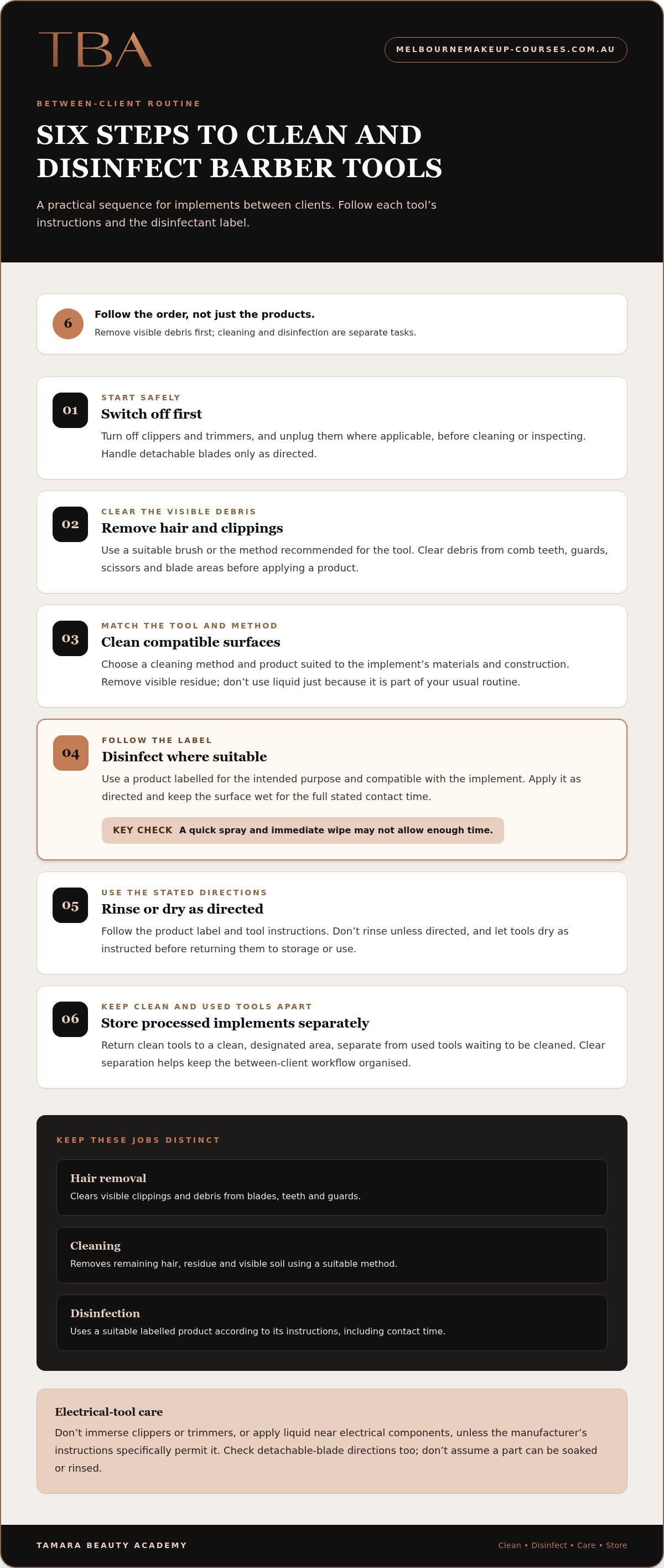
A consistent between-client process helps keep your station organised and prevents used implements from being carried into the next service. Cleaning and disinfection have different jobs: cleaning removes hair, visible debris and product residue, while disinfection uses a suitable labelled product according to its directions, including the full contact time. Don’t skip either step or treat one as a substitute for the other.
Use this sequence as a practical guide, adapting it to each tool’s manufacturer instructions and the disinfectant label. If directions differ, don’t improvise with water, sprays or soaking methods.
Electrical tools need particular care around motors, charging ports, switches and other electrical components. Don’t immerse a clipper or trimmer, or apply liquid near these areas, unless the manufacturer’s instructions specifically permit it. Use the recommended brush or method to clear hair around the blades, and avoid forcing debris deeper into the tool.
Check the instructions for detachable blades as well. A blade that comes off the clipper may have different cleaning directions from the electrical body. If a tool gets wet in a way its instructions don’t allow, or shows damage, stop and follow the manufacturer’s guidance rather than continuing to use or clean it as usual.
Clear steps make barber tool maintenance easier to repeat during a busy day. If you’re building these habits alongside practical technique, explore the barbering courses and training options as part of developing a considered approach to your craft.
Clean blades still need appropriate mechanical care. Oiling can support blade movement, but the frequency, amount and method depend on the clipper. Follow the tool maker’s instructions for blade care because designs and oiling requirements vary. A routine that suits one model may not suit another, so avoid relying on a universal number of drops or schedule.
Include blade checks in your barber tool maintenance routine. Notice changes rather than pushing on when something seems wrong. An inspection isn’t a diagnosis; it’s a prompt to pause, consult the manufacturer’s guidance and arrange appropriate assessment if needed.
Start with the clipper switched off and prepare the blade as the manufacturer directs. Apply only the specified oil, in the amount and at the points described for that tool. Keep oil away from electrical components, and don’t add it to the housing or other areas unless the instructions say to.
Instructions may tell you to run the clipper briefly after oiling, wipe the blades or remove excess oil. Others may give different steps. Follow the directions for your model rather than assuming one routine fits all. Disinfectant isn’t a substitute for blade oil, and neither general-purpose lubricant nor household oil should replace the oil specified by the maker. Use the correct product and method.
As you check clippers and trimmers, look and listen for changes. Compare what you notice with the tool’s normal operation, without trying to diagnose the cause yourself.
Stop using a tool that appears damaged or unsafe. Follow the maker’s guidance on assessment and repair; sharpening, replacement parts and servicing depend on the tool’s design. Reliable, well-cared-for equipment supports controlled cutting practice, including the blending techniques explored in Barber Clipper Fading Guide: Blend a Clean Fade Step by Step. Focus on careful observation, appropriate maintenance and knowing when to pause.
A schedule turns good intentions into repeatable barber tool maintenance. Use the table as a starting template, not a universal rulebook. Adjust it to how often each tool is used, and follow the manufacturer’s care instructions and any disinfectant product directions. If a tool’s instructions call for more frequent care, follow those directions.
| When | Practical checks |
|---|---|
| Between clients | Complete the appropriate cleaning and disinfection steps for reusable tools. Keep clean implements separate from used ones, and return processed tools to their designated storage area. |
| At day’s end | Clear remaining hair from tools, inspect blades, guards and cords for visible concerns, and store dry equipment in a clean, dry place. Put accessories back in their organised spots. |
| Weekly, as a template | Review your station and accessories. Check that guards and detachable parts are accounted for, storage remains clean and dry, and your maintenance notes don’t show recurring issues. |
| Periodically, guided by use and instructions | Review manufacturer-recommended care tasks and the condition of tools that see frequent use. Follow up on logged concerns, and arrange assessment, sharpening or repair when the tool’s condition or guidance indicates it’s needed. |
Keep the checklist visible near your station or in a maintenance log. Between clients, follow the relevant hygiene process for each reusable implement. At closing, take a deliberate pass over your equipment rather than putting everything away in a rush. A short note such as “trimmer sounds different” or “guard feels loose” gives you a clear reminder to follow up without trying to diagnose the issue on the spot.
Save this summary: between clients, process reusable tools appropriately; at day’s end, clear hair, inspect and store equipment dry; periodically, review manufacturer guidance and follow up on logged concerns.
There’s no single service interval that suits every blade or clipper. Use the tool’s condition, how often it’s used and manufacturer guidance to decide when to seek sharpening or repair. If a tool appears damaged, repeatedly operates differently or can’t be kept clean or used safely, remove it from service while you follow the appropriate next steps. Log the concern so it doesn’t disappear in the pace of a busy week.
Ready to build professional habits alongside practical barbering skills? Explore barbering courses and develop your craft through structured training.
Barbering is built from practical skills, and the way you prepare your tools is part of the craft. A familiar care routine gives each service a clear starting point: check your equipment, organise your station and focus on the technique you’re practising. It won’t replace cutting skill, but it can help you approach your work with greater composure and purpose.
Practise the care checklist until it becomes a natural part of preparing your tools. Work through the steps in the same order, use the manufacturer’s directions for each item and allow time to check that your equipment is ready for the task ahead. Consistency matters more than rushing through the process.
An organised station can also make transitions between tasks smoother. When tools and accessories have designated places, you can find what you need without searching through a cluttered work area. Cleaning, inspection and storage then become part of preparation, rather than chores you remember only after a tool starts behaving differently.
These small routines connect with broader barbering skills: preparation, control and responsible practice. As you repeat them, you’ll become more familiar with your equipment and better able to notice when something needs attention. That awareness can help you feel more settled as you build foundational skills, whether you’re practising a technique or preparing for a service.
For beginners, structured learning can bring practical skills and equipment-care habits together. Tamarua Beauty Academy offers barbering courses in Melbourne, with practical training and flexible learning options, including on-site and live-online short courses. Learners across Victoria, including Melbourne city, the Eastern suburbs, western suburbs, Brimbank, Hobsons Bay, Maribyrnong, Melton and Wyndham, can explore training options while developing habits that support confident practice.
You don’t need to have your whole career mapped out before exploring barbering. Start with curiosity, practise the fundamentals and give yourself room to grow. A steady approach to barber tool maintenance is one part of that foundation, alongside learning how to prepare, handle tools and develop control through practice.
If barbering is a craft you’re keen to explore, take a look at the barbering course options and consider whether structured training is the right next step for you.
Your professional style is shaped by the habits you practise before, during and after each service. Treat barber tool maintenance as part of preparing to work, not an extra task to squeeze in later. As that mindset becomes familiar, you can build on it with new techniques, stronger control and a more assured approach to your craft.
If you’re curious about barbering, you don’t need to have your whole career mapped out before you begin. A course can help you develop practical skills and explore where your interest might lead. Tamara Beauty Academy offers barbering courses for people ready to take that first step and build confidence through learning.
Ready to explore barbering training? Explore barbering course options and take a positive step towards building your skills.
Clean and disinfect reusable clippers between clients, then do a fuller tidy and condition check at day’s end. The between-client step supports hygiene each time the tool is used for another client; the closing routine clears accumulated hair and gives you a chance to notice wear before storage. Use a disinfectant only as its label directs, including the stated contact time. If a clipper isn’t shared during a session, still follow its care instructions and the product directions.
No. Clipper oil and disinfectant have different jobs: oil is for blade care, while a suitable disinfectant is used on compatible surfaces according to its label. Applying oil won’t replace the hygiene steps for a blade between users. Keep the products distinct in your station, and follow the clipper maker’s directions for oiling as well as the disinfectant label’s application and contact-time instructions.
Switch the clipper off and unplug it where applicable, then check its manual before choosing a cleaning method. A brush may be suitable for clearing clippings from the blade area, while liquid near a motor or charging port may be unsuitable. Don’t immerse the electrical body or spray it unless the manufacturer permits that method. Treat detachable parts according to their own instructions rather than assuming they can be cleaned like the clipper.
Use the blade oil specified or recommended by the clipper manufacturer, and follow its application directions. The instructions identify where the oil belongs and how much to use for that model. Avoid substituting household oil, general-purpose lubricant or disinfectant, as these products aren’t interchangeable. If you’ve misplaced the manual, look for care information from the tool’s maker before applying anything. The right approach depends on the clipper design.
Oil the blades at the frequency stated in the clipper’s instructions, since the recommended routine can depend on the tool and how it’s used. A clipper used throughout a busy day may need a different care rhythm from one used occasionally, but don’t guess at an interval. A reliable barber tool maintenance habit is to consult the manual, note the required oiling steps and keep to them as your use changes.
Arrange assessment when you notice visible blade damage, unusual movement or a change in operation, and use the manufacturer’s advice to guide what happens next. Don’t assume every blade can be sharpened or that replacement is always the right fix; options depend on the blade and clipper design. If a blade looks damaged or the tool seems unsafe, stop using it until it has been appropriately assessed.
Not necessarily. Scissors don’t have the same electrical components as clippers, but their materials, finish and construction still affect suitable cleaning and disinfection methods. Follow the scissors’ care instructions, including how to remove residue and whether a particular product is appropriate. Don’t automatically use a clipper routine, especially if it involves oil or liquid application. Keep scissors dry and store them as directed to support their condition.