Awarded Top 4 Education Facility in Australia by the MAGAP (Asia Pacific)


What if your next makeup booking came not from posting more, but from making it easier for Melbourne clients to trust your work? If you’re wondering how to get makeup clients in Melbourne, it’s understandable to feel unsure where to begin, especially when your portfolio is still growing and you’re building confidence in your professional presence.
A steady client base doesn’t have to rely on one social platform or a lucky referral. Start with visible proof of your skills, genuine local relationships and a simple follow-up habit that helps turn enquiries into bookings. With a clear plan, you can attract suitable clients while developing your portfolio.
This guide covers practical ways to present your work, build trust with prospective clients and choose where to focus your marketing, from social media to referrals and local partnerships. You’ll also find ways to keep developing your technique and professional readiness, so each step supports a more confident, sustainable makeup career.
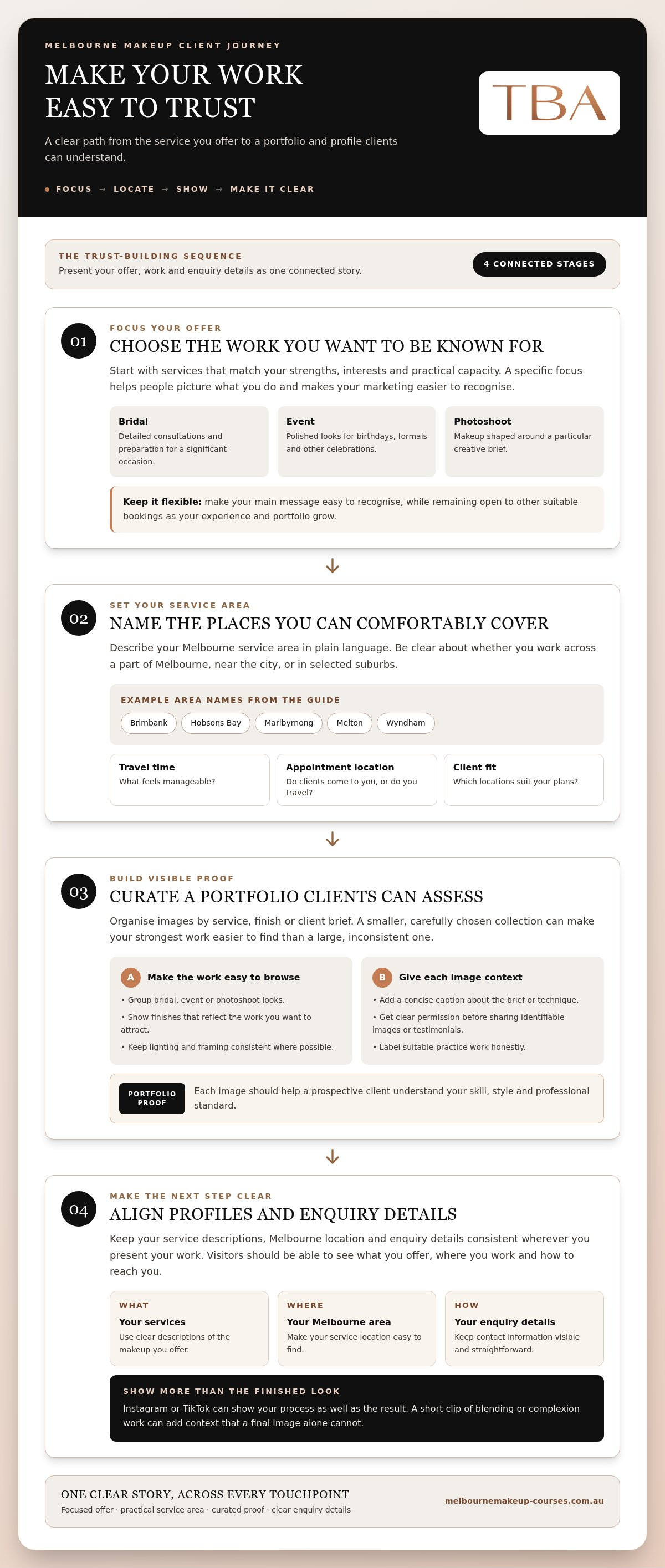
Finding your first clients, or attracting more of the work you enjoy, can feel daunting when your skills cover several looks and occasions. A focused starting point helps people understand what you do and makes it easier to decide where to promote your work. If you’re working out how to get makeup clients in Melbourne, begin by describing the service you most want to be known for and the people likely to need it.
Melbourne offers varied opportunities, from city events and photoshoots to weddings and celebrations across the eastern and western suburbs. You don’t need to appeal to every client at once. A clear offer gives your social posts, portfolio and conversations a consistent thread, while leaving room to accept other suitable bookings.
Start with work that matches your strengths, interests and practical capacity. Bridal makeup may suit an artist who enjoys detailed consultations and preparing for a significant occasion. Event makeup can appeal if you like creating polished looks for birthdays, formals or other celebrations. Photoshoot makeup may be a fit if you’re drawn to collaborating around a particular brief. To explore the role of a makeup artist, consider how different specialisations call for different techniques and ways of working.
Make your starting offer specific enough for a potential client to picture. You could focus your early portfolio on soft, polished event looks for clients in Melbourne’s eastern suburbs, or bridal makeup for people planning a wedding in the west. Think about the looks you can demonstrate confidently, the appointments you prefer and how many clients you can realistically accommodate. A clear niche helps you explain your value, show relevant proof and speak to clients who are likely to connect with your style.
You’re not locking yourself into one category. Treat this as a starting focus, then take on other appropriate work as your experience and portfolio grow. The goal is to make your main message easy to recognise, not to turn away every enquiry outside it.
Describe your service area in plain language that reflects where you can comfortably work. You might say you work across Melbourne’s west, or that you’re based near the city and take appointments in selected eastern suburbs. If you’re focusing on Melbourne’s west, naming areas such as Brimbank, Hobsons Bay, Maribyrnong, Melton and Wyndham helps potential clients understand where you mean. For a broader Melbourne audience, be clear whether you cover the city, the eastern suburbs or both. Use only the locations that fit your plans, rather than listing every suburb as an exhaustive boundary.
Before publishing your wording, consider your usual travel time, whether clients come to you or you travel to an appointment, and the preferences of the people you want to serve. Keep the description straightforward, then adjust it as you learn which locations suit your schedule. A manageable service area makes your offer easier to understand and helps potential clients quickly recognise whether it’s relevant to them.
A potential client wants more than a glimpse of a finished look. They’re looking for evidence that your technique suits their needs, that your work is consistent and that it’s straightforward to enquire. Build trust with a well-organised portfolio, clear service descriptions, reviews you have permission to share and visible contact details. Social media and search profiles are ways to present those assets, not substitutes for them.
This makes it easier to decide what to improve. A polished portfolio supports your presence across Instagram, TikTok and a website, while a clear enquiry path helps interested people take the next step. For anyone learning how to get makeup clients in Melbourne, the goal is to make your work easy to assess and the next step easy to find.
Organise images so visitors can browse by service type, finish or client brief. You might group bridal looks separately from event or photoshoot makeup, then include finishes that reflect the work you want to attract. A smaller, carefully chosen portfolio is more useful than a large collection that feels inconsistent or makes your strongest work hard to find.
Keep lighting and framing consistent where possible, and add a concise caption explaining the brief or technique. Before sharing identifiable images or testimonials, get clear permission from the client. If your portfolio is still developing, use suitable practice work and label it honestly. Each image should help a prospective client understand your skill, style and professional standard.
Keep your service descriptions, Melbourne location and enquiry details consistent across the profiles you use. A visitor shouldn’t have to guess what you offer, where you work or how to reach you. Use a direct call to action such as “Send an enquiry with your event date and preferred look”, then make sure the contact method is visible and easy to use.
Instagram or TikTok can help you show both your process and finished looks. A short clip of blending or complexion work gives context that a final image alone can’t, while a caption can explain the service or brief. You don’t need to build your plan around follower counts. Focus on presenting useful, consistent proof and making it simple for interested people to get in touch.
As your technique develops, update your portfolio to reflect your progress and the services you feel ready to promote. If structured practice would help strengthen your foundation, explore makeup course options that include practical instruction. Then choose your strongest examples and make sure each profile points to one clear enquiry step.
You don’t need to post on every platform, join every directory and approach every business at once. Choose channels based on the clients you want to reach, the area you serve and the proof you can share consistently. A small, well-managed mix is easier to sustain and gives you room to see which conversations lead to relevant enquiries.
The right channel mix follows your client type and service area, not pressure to be visible everywhere. Use the comparison below to decide where to begin. “Trust and proof” describes how readily each channel can help you build visible examples of your work or trusted connections, not a promise of bookings.
| Channel | Audience fit | Effort | Trust and proof |
|---|---|---|---|
| Social content | People drawn to visual style and process | Ongoing, with regular content | Strong space to show looks and technique |
| Local search | People looking for makeup services nearby | Set-up, then occasional updates | Clear details help people assess your offer |
| Referrals | People connected to past clients or collaborators | Built through genuine relationships | Personal recommendations can add context |
| Creative collaborations | People reached through related creative work | Planning and coordination required | Creates shared work and professional connections |
Instagram and TikTok are visual spaces for showing your style, process and finished looks. A short sequence can reveal the care behind an application, while a finished image makes your aesthetic easy to recognise. Connect each post to the services you want to promote and the Melbourne area you serve, whether that’s the city, the eastern suburbs or the west. Focus on useful, consistent examples rather than follower counts.
Local search serves a different purpose: it helps people understand what you offer and how to enquire when they’re looking for makeup nearby. Keep your service description, location and contact steps plain and consistent. Someone who finds your profile or listing should be able to see whether your work suits their occasion and how to take the next step.
Photographers, hairstylists, fashion stylists and event professionals may share audiences with you. Start by building a genuine connection and discussing a collaboration that suits both parties, such as creating portfolio work around a clear brief. Agree on expectations and credit arrangements so everyone understands how the work may be presented.
Word of mouth is also shaped by the experience you create: communicate clearly, arrive prepared and make the appointment feel considered. Afterward, a brief, gracious follow-up can thank the client and invite feedback without putting them under pressure to refer others. As you decide how to get makeup clients in Melbourne, test a couple of channels that fit your goals, then review which ones bring relevant conversations and are realistic to maintain.
A practical plan gives your marketing direction without expecting instant results. Over four weeks, focus on one useful step at a time: clarify your offer, share evidence of your work, build local connections and learn from the enquiries you receive. This approach to how to get makeup clients in Melbourne is a starting rhythm you can adapt to your schedule, not a promise of bookings.
Keep each week manageable. Choose actions you can complete alongside your makeup work, then note what you did so you can assess it later.
A prompt, considered reply helps set a professional tone. Prepare a short response that thanks the person for getting in touch, acknowledges their brief and asks for the details you need, such as the event date, location, preferred look and timing requirements. Tailor your response to the enquiry rather than relying on a message that feels automatic.
Keep a simple record of the enquiry source, when you responded and whether the person booked. A basic spreadsheet or notebook is enough. Record only what helps you manage enquiries and evaluate your marketing; avoid collecting personal details you don’t need. If someone hasn’t replied, follow up politely where appropriate, then leave the decision with them.
At the end of the month, look for practical improvements. Are people unclear about the service, asking the same question or taking time to respond after receiving your details? Use those patterns, along with client feedback, to improve your wording, response timing or follow-up. If developing your technique is part of your next step, explore Melbourne makeup course options to support your professional growth.
A clear offer and polished portfolio help people understand your work, but the skill behind each look is what gives you confidence to show up professionally. Training can help you strengthen your technique and readiness for client-facing work. It won’t guarantee enquiries, bookings, income or employment, but it can give you a structured space to practise and refine your craft.
Practical demonstrations let you observe how techniques are applied, while hands-on instruction gives you the opportunity to put them into practice. Pay attention to details that affect the finished look, such as blending, complexion preparation and adapting your approach to a brief. Deliberate practice helps you notice what’s working and where you’d like more consistency.
That consistency supports the client journey you’re building. When you can recreate a polished standard across different looks, it becomes easier to select portfolio work that reflects your capabilities and describe your services with confidence. Practise with a clear purpose: choose a technique to focus on, create a look, review the result and note what you’d adjust next time. Small, considered improvements can shape stronger professional habits.
Client-facing readiness also includes listening carefully, understanding the requested look and communicating clearly about the brief. These skills develop alongside application technique, helping you approach enquiries with a grounded understanding of what you can offer. Keep your claims aligned with your experience, and let your work show your progress.
Your learning needs may change as your experience grows. If you’re starting out, you may want to build a foundation in core techniques; if you already have experience, you might focus on refining particular skills. Think about the looks you want to create, the techniques you’d like to practise and how learning can fit around your other commitments. For an overview while comparing training pathways, refer to Makeup Courses: Choose the Right Training in 2026.
Tamarua Beauty Academy is based in Melbourne and offers on-site and live-online short courses with flexible scheduling. Practical demonstrations and hands-on instruction connect learning with the work you’re building, and a free consultation can help you consider your training goals and relevant options. The Academy offers makeup courses alongside training in other beauty disciplines.
Makeup training is one part of developing your professional journey. Pair it with deliberate practice, thoughtful portfolio updates and clear communication, then keep reviewing what you learn from each client interaction. Those habits help you build confidence in your craft without treating any course as a shortcut to a guaranteed client base. Explore makeup training options to consider a practical next step for your skills.
Building a client base is a practice in its own right. Give yourself room to learn from each conversation, refine how you present your work and let your professional identity take shape over time. You don’t need every detail mapped out before you begin. Choose one practical step that feels achievable, then build on it with intention.
If you’re still exploring how to get makeup clients in Melbourne, remember that growth comes from more than visibility alone. Strong technique can help you feel surer of the work you share and the way you speak about your services. Investing in your development is a meaningful step towards creating a career that reflects your talent and ambition.
Explore makeup training pathways and find a learning direction that supports your next stage. Your skills can keep growing, and so can your vision for what’s possible.
Build your client activity around the time you can reliably set aside. Choose a limited number of appointment windows, then make them clear in your enquiry replies so clients can plan around your availability. Keep a simple record of which services people ask about and where they found you. This helps you decide whether to adjust your schedule or focus your part-time effort on a particular type of work.
Ask for the event date, getting-ready location, preferred finish and the time the makeup needs to be completed. Clarify whether they’re booking for themselves or a group, and whether there are particular preferences or sensitivities they want to discuss before the appointment. Confirm the agreed service, timing and any relevant preparation details in writing. A clear record helps both of you share the same expectations.
There isn’t one lead time that suits every appointment. Encourage clients to enquire once they know their event date, especially for weddings or occasions with a fixed schedule, as this gives you both time to discuss the brief and logistics. For less time-sensitive events, clients can still ask closer to the date. Avoid promising availability before you’ve reviewed your calendar and appointment requirements.
No, a website isn’t essential when you’re starting out, provided people can see your work and understand how to enquire. A well-maintained social profile can act as an initial showcase. If you create a website later, use it to bring key details together, such as your services, portfolio, Melbourne location, contact method and answers to common questions. Choose a setup you can keep current.
Ask each prospective client for the appointment suburb and whether they expect you to travel or will attend your chosen location. Group enquiries by area when planning your calendar, and allow realistic travel time between appointments rather than assuming suburbs are close together. Keep a consistent note of location and appointment details so you can respond clearly and assess whether the booking fits your schedule.
Yes, but get clear permission before sharing images that identify a client. Explain where you’d like to use the photos, such as your portfolio, social media or promotional material, and agree on whether their name will appear. Keep permission for images separate from permission to share a testimonial, as a client may be comfortable with one but not the other. Respect any limits they set.